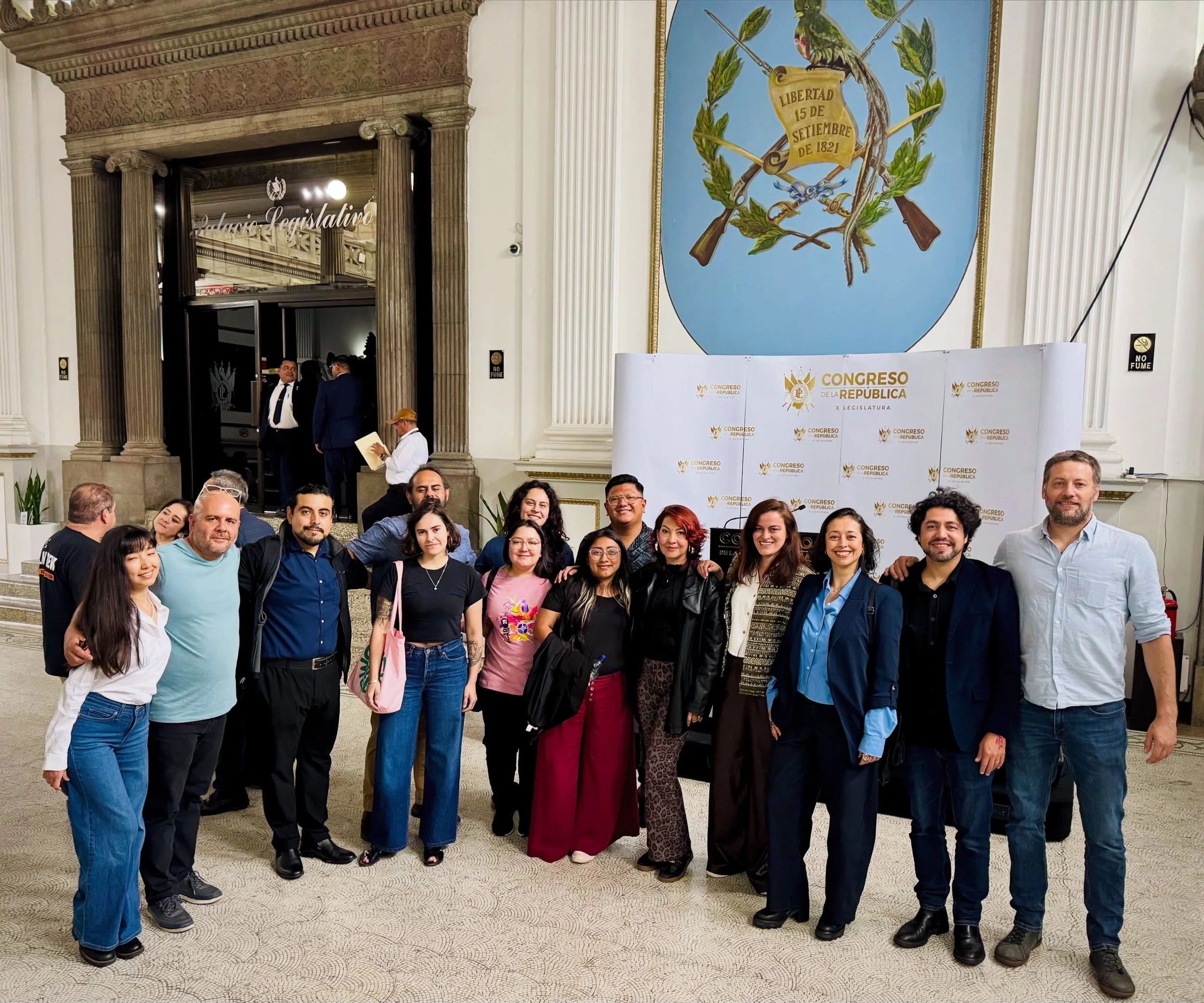
Members of the Academia Guatemalteca de Artes y Ciencias Cinematográficas at the Guatemalan Congress. Photo: Academia Guatemalteca de Artes y Ciencias Cinematográficas.
In a historic victory for Guatemala's filmmaking community, the country's Congress approved a long-awaited national Film Law on Tuesday, November 10, marking a major milestone in efforts to establish a sustainable framework for the development, production, distribution, and preservation of Guatemalan cinema.
Passed with 132 votes under an expedited legislative procedure, the legislation, designated Decree 27-2026, comes after nearly two decades of advocacy by filmmakers and cultural organizations seeking greater institutional recognition and public support for the country's film industry.
At the center of the new law is the creation of the Instituto Guatemalteco de Cine (Guatemalan Film Institute), a decentralized public institution tasked with promoting and coordinating the development of national cinema. The institute will oversee several initiatives, including a national film commission, a cinematheque dedicated to the preservation of the country's audiovisual heritage, and programs supporting film education, research, production, and distribution.
The legislation also establishes the Fondo de Fomento del Cine (Film Development Fund), designed to provide financial support for filmmaking activities, including production, distribution, exhibition, professional training, and the preservation and restoration of cinematic works. The fund represents a significant step toward creating a public financing structure for Guatemalan filmmakers, who have historically relied on independent financing, international coproductions, and support from foreign cultural institutions.
Another major provision is the establishment of the Escuela Superior Nacional de Cine (National Film School), intended to expand opportunities for professional training and cultivate new generations of filmmakers and audiovisual professionals.
The law also introduces fiscal incentives aimed at attracting domestic and international investment in film production, including tax credits and partial investment reimbursements. These measures seek to strengthen Guatemala's position as a production destination while encouraging the growth of its local audiovisual industry.
The legislation follows a lengthy and sometimes contentious legislative process. Although the initiative had been under consideration for years, its final approval came after revisions addressing concerns about financing and taxation. A proposed levy on airline tickets purchased by foreign visitors was eliminated from the final version, while the allocation of public resources to the new film institute remains subject to government budgeting decisions.
The approval comes at a time when Guatemalan cinema has achieved growing international recognition, with filmmakers such as Jayro Bustamante, César Díaz, Pamela Guinea, Anaïs Taracena, Sebastián Lojo, Joaquín Ruano, and Julio Hernández Cordón bringing the country's stories to major international film festivals and audiences. Their work, alongside that of a new generation of filmmakers, has helped establish Guatemala as an increasingly visible presence in Latin American cinema despite limited domestic infrastructure and institutional support.
The Academia Guatemalteca de Artes y Ciencias Cinematográficas and the Asociación Guatemalteca del Audiovisual y la Cinematografía (AGA Cine) have been among the organizations advocating for a national film law, emphasizing its potential to generate employment, attract investment, and strengthen the country's cultural production.
While the law's long-term impact will depend on its implementation, funding, and institutional independence, its approval marks a turning point for Guatemala's film community. Beyond supporting individual productions, the new framework offers the possibility of developing a more comprehensive national film ecosystem, connecting artistic creation with education, preservation, distribution, and economic development.
For a country whose filmmakers have earned international acclaim while working with limited resources, the passage of the Film Law opens a new chapter in the history of Guatemalan cinema.