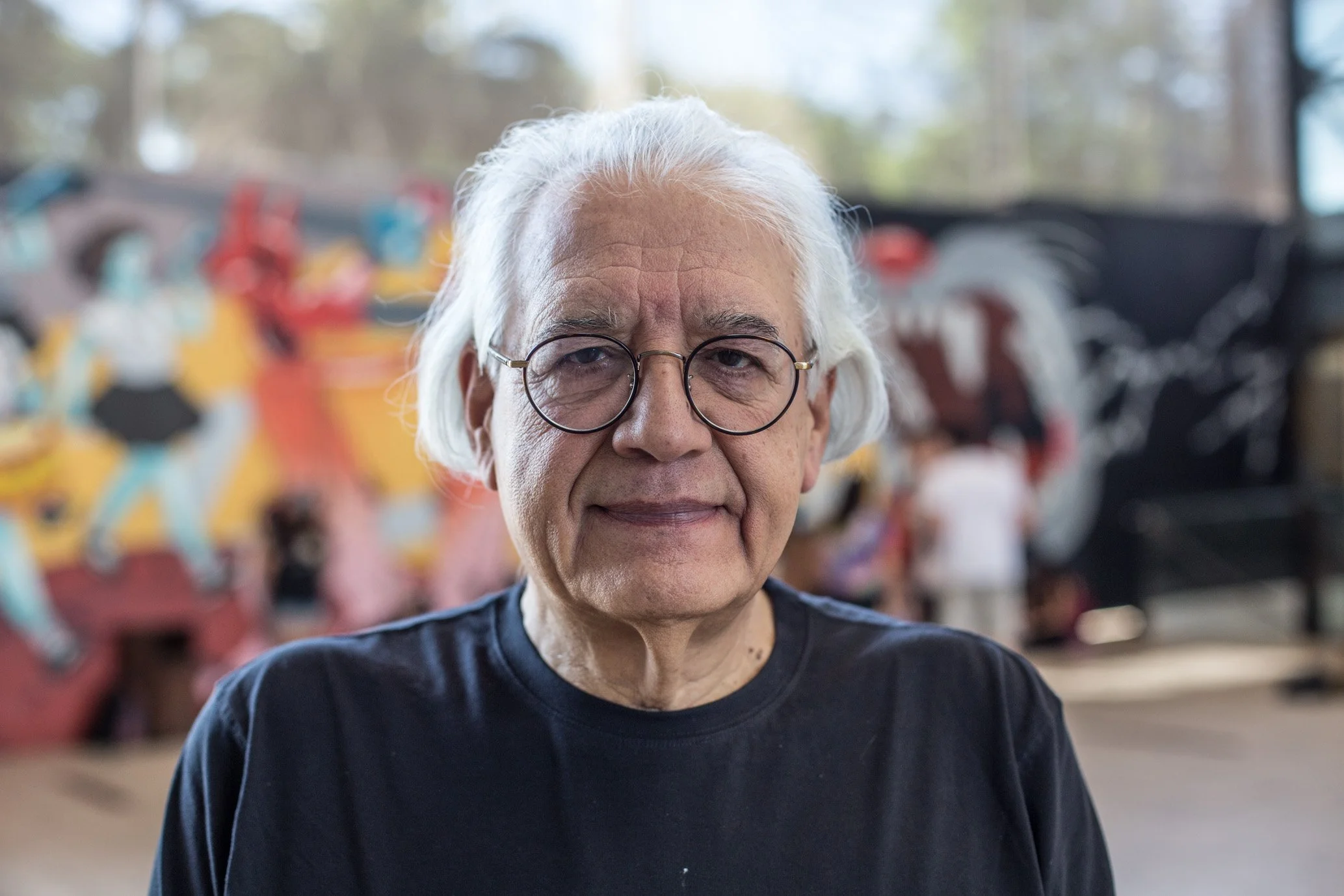
Patricio Guzmán, master Chilean documentarian whose films gave shape to the memory and political conscience of Latin America, passed away today in Paris at the age of 85. A filmmaker, screenwriter, researcher, theorist, and teacher, Guzmán dedicated over five decades to chronicling his homeland. For all of us at Cinema Tropical, where we have had the honor of presenting, championing, and distributing his films in the United States across many years, his passing marks a profound loss for world cinema.
Born in Santiago in 1941, Guzmán studied filmmaking at the Official School of Cinematographic Arts in Madrid before returning to Chile in the early 1970s, eager to capture the social democratic experiment of Salvador Allende’s Popular Unity government. His early feature The First Year / El primer año (1972) caught the attention of French director Chris Marker, who stepped in to help distribute the film in Europe. As political opposition intensified and raw film stock became impossible to purchase in Chile, Marker personally arranged for thousands of feet of 16mm film to be shipped from Paris to Santiago, enabling Guzmán and his young crew to keep filming the mounting crisis on the streets.
That footage was captured under extreme danger. Following the military coup on September 11, 1973, Guzmán was detained by Pinochet’s forces in Santiago’s National Stadium for ten days, where he was subjected repeatedly to simulated executions. After gaining his release, he fled into exile in Cuba, Spain, and later France, though the production was struck by tragedy: his chief cinematographer, Jorge Müller Silva, was arrested by the secret police (DINA) in late 1974 and became one of Chile’s disappeared.
Working from exile in Havana alongside editor Pedro Chaskel, Guzmán assembled the smuggled rolls into The Battle of Chile / La batalla de Chile (1975–1979). The landmark three-part chronicle—The Insurrection of the Bourgeoisie / La insurrección de la burguesía, The Coup d’Etat / El golpe de estado, and The Power of the People / El poder popular—premiered across successive editions of the Cannes Film Festival. Hailed as one of the greatest documentaries ever made by Sight and Sound and Time Out, one of the ten best political films in the world by Cineaste, and one of the most significant political films of all time by The New Republic, The Battle of Chile / La batalla de Chile stands as the cornerstone of Guzmán's cinema.
Guzmán’s commitment to historical memory never faltered throughout decades in exile. In 1997, he returned to screen The Battle of Chile / La batalla de Chile for young Chilean students who had grown up under dictatorship censorship, a journey captured in his moving essay Chile, Obstinate Memory / Chile, la memoria obstinada (1997). That same year, to foster a new generation of non-fiction filmmakers in his home country, Guzmán founded the Santiago International Documentary Film Festival (FIDOCS), where he served as president. He continued to examine the nation’s history through biographical portraits like Salvador Allende / Salvador Allende (2004).
Beyond his directing, Guzmán was a foundational theorist and educator who reshaped how documentarians approach non-fiction storytelling across the Spanish-speaking world. Through his widely influential text Screenwriting for Documentary Film (El guion en el cine documental) and decades of teaching—including masterclasses at Cuba’s International Film and Television School (EICTV) in San Antonio de los Baños and institutions across Europe and the Americas—he argued passionately that non-fiction cinema demanded the same narrative architecture and poetic freedom as fiction.
By building creative alliances with European cultural institutions and public television networks during years when Latin American film infrastructure was suppressed, he established a sustainable model for independent Latin American directors working from exile and abroad.
In his later decades, Guzmán evolved his style into a singular mode of cinematic poetry linking Chilean geography directly to historical trauma and loss. His acclaimed late trilogy—Nostalgia for the Light / Nostalgia de la luz (2010), The Pearl Button / El botón de nácar (2015, winner of the Silver Bear for Best Script at the Berlinale), and The Cordillera of Dreams / La cordillera de los sueños (2019, winner of the L'Œil d'or at Cannes)—explored the Atacama Desert, the Pacific Ocean, and the Andes Mountains as physical witnesses to both cosmic time and state violence. He returned to direct political chronicle with My Imaginary Country / Mi país imaginario (2022), capturing how the 2019 popular uprising in Santiago sparked nationwide political change.
Throughout Cinema Tropical’s history, partnering with Patricio Guzmán and his wife and producer, Renate Sachse—alongside distributor Icarus Films—has been one of our organization's core pillars. In 2023, coinciding with the 50th anniversary of the September 11 coup, Chile’s Ministry of Culture awarded Guzmán the National Award for Representation and Audiovisual Arts, praising his work's "essential commitment to social justice, and very profoundly to truth and memory."
To celebrate the award and mark the historic 50th anniversary, Cinema Tropical and Icarus Films co-presented the unprecedented NYC-wide retrospective series Patricio Guzmán, Dreaming of Utopia: 50 Years of Revolutionary Hope and Memory. Spanning nine films and special guest conversations across three venues simultaneously, the series featured new 2K restorations of The Battle of Chile / La batalla de Chile at BAM Rose Cinemas and The First Year / El primer año alongside Salvador Allende / Salvador Allende at Anthology Film Archives, with the IFC Center hosting his late geographic trilogy and My Imaginary Country / Mi país imaginario.
Guzmán famously wrote that "a country without documentary cinema is like a family without a photo album." Through his courage, artistic vision, and unwavering moral clarity, he gave Chile—and the world—an irreplaceable album of memory, resistance, and hope. Cinema Tropical extends its deepest condolences to his family, collaborators, and all those touched by his extraordinary films.