Dolores by Peter Bratt
Dolores Huerta, the pioneering Mexican-American labor leader, feminist, and civil rights activist whose tireless advocacy helped transform the struggle for social justice in the United States, died Wednesday, October 28, at her home in Bakersfield, California. She was 96.
One of the most influential figures in the history of the Chicano movement, Huerta co-founded the National Farm Workers Association in 1962, which later became the United Farm Workers, helping lead historic strikes and boycotts that secured landmark protections for agricultural workers. Over more than six decades, she championed labor rights, immigrant rights, women's equality, and political empowerment, inspiring generations with the rallying cry she coined: "¡Sí se puede!"
Her extraordinary life and legacy have also been extensively documented on film, making her a recurring presence in the history of Chicano and Latino cinema. From the pioneering documentaries of the 1970s to contemporary films exploring labor struggles, feminism, and cultural identity, Huerta's appearances on screen reflect both the evolution of Latino filmmaking and the enduring relevance of the movements she helped shape.
Among her earliest cinematic appearances was Yo Soy Chicano (1972), the groundbreaking documentary produced and written by pioneering Chicano filmmaker Jesús Salvador Treviño and directed by Barry Nye. Considered the first Chicano-produced documentary about the Mexican-American experience to be broadcast nationally, the film explored the history of the Chicano movement and its struggle for political and cultural empowerment.
Huerta also contributed her voice to Chicana (1979), the groundbreaking short documentary by filmmaker Sylvia Morales, which recovered the often-overlooked contributions of Mexican and Mexican-American women to history, culture, and political struggles. Three decades later, Morales returned to Huerta in A Crushing Love: Chicanas, Motherhood and Activism (2009), an intimate documentary examining the lives of five prominent Chicana activists navigating the competing demands of motherhood and political commitment. Alongside figures including Cherríe Moraga, Elizabeth Martínez, Alicia Escalante, and Martha Cotera, Huerta reflects on the personal sacrifices and complexities of dedicating a lifetime to social change.
Her central role in the farmworkers' movement has been chronicled in numerous documentaries, including The Fight in the Fields: Cesar Chavez and the Farmworkers' Struggle (1997), The Delano Manongs: Forgotten Heroes of the United Farm Workers (2014), which recovers the contributions of Filipino agricultural workers, and Food Chains (2014), an examination of labor exploitation in the American food industry.
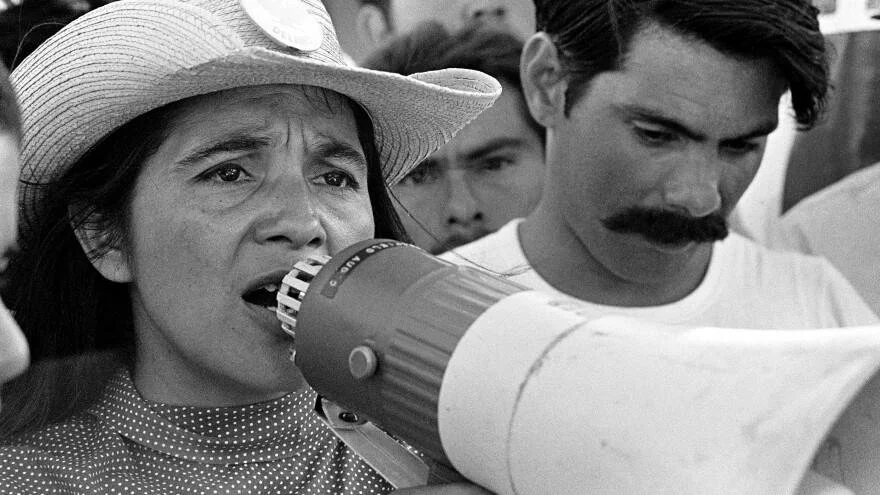
Perhaps the most significant cinematic portrait of her life came with Dolores (2017), the acclaimed feature documentary by Mexican-American filmmaker Peter Bratt. Executive produced by musician Carlos Santana, the film premiered at the Sundance Film Festival before receiving a theatrical release and a national PBS broadcast.
Through extensive archival footage and intimate interviews with Huerta, her family, and fellow activists, Bratt's documentary offers a sweeping account of her political achievements while confronting the sexism, personal sacrifices, and historical marginalization that shaped her experience. More than a conventional biography, Dolores challenges the male-centered narratives of the American labor movement, examining how Huerta's contributions were often overshadowed in historical accounts and bringing renewed attention to her independent leadership and achievements.
Her influence also extended into narrative cinema, with actress Rosario Dawson portraying her in Cesar Chavez (2014), the biographical drama directed by Mexican actor and filmmaker Diego Luna.
Huerta's appearances in films such as Miss Representation (2011), Carlos Almaraz: Playing with Fire (2019), and A Song for Cesar: Beware a Movement That Sings (2021) further demonstrate the breadth of her cultural and political influence, connecting her activism to broader conversations about gender, art, and the role of cultural expression in social movements.
More recently, she appeared in American Pachuco: The Legend of Luis Valdez (2026), David Alvarado's award-winning documentary about the pioneering Chicano playwright and filmmaker whose work with El Teatro Campesino emerged from the farmworkers' movement. Winner of the Audience Award for U.S. Documentary at the Sundance Film Festival, the film revisits the cultural and political ferment of the Chicano movement and the essential role of theater in the struggle for labor rights.
Huerta was also the subject of the 2025 documentary short Seeds of Change: The Life and Legacy of Dolores Huerta, directed by Ari Fishman, in which she reflected on her decades of organizing and the importance of passing the struggle for justice to future generations.
Earlier this year, Huerta revealed that César Chávez had sexually abused her in the 1960s and that she had remained silent for decades to protect the farmworkers' movement. The revelations have prompted a reassessment of Chávez's legacy and the history of the movement they helped build together.
Over the decades, Huerta appeared in numerous documentaries, speaking about the struggles she helped lead and the people she worked alongside. These films also capture her humor, candor, and unwavering commitment to activism, offering a portrait of a woman who continued organizing well into her nineties.
From the early days of Chicano cinema to the documentaries of recent years, Huerta remained a familiar and formidable presence on screen. Her passing marks the end of an extraordinary life, but her voice and her story live on in the films she leaves behind.