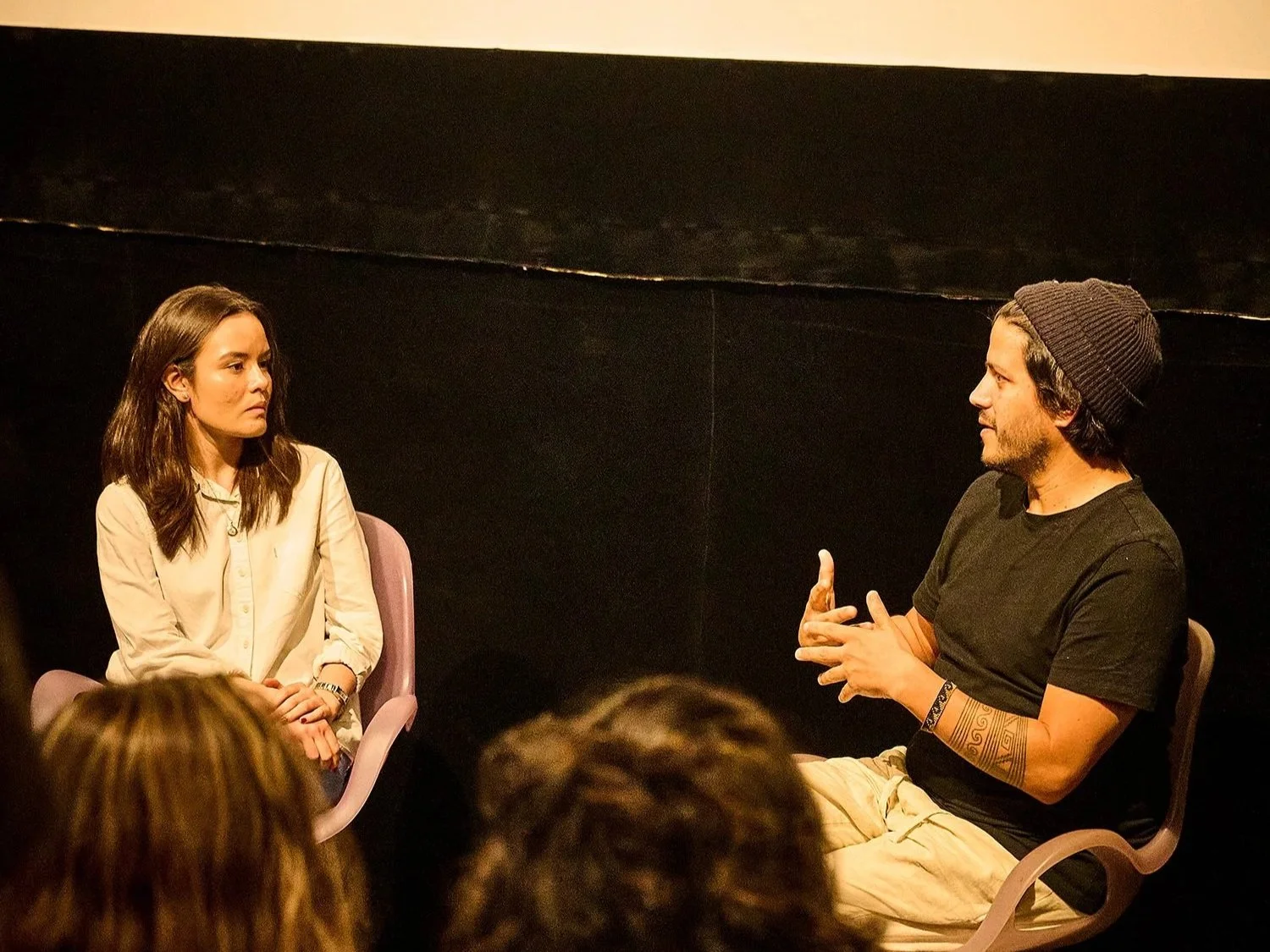
Huaquero director Juan Carlos Donoso Gómez (right) and Cinema Tropical's Natalia Hernández Moreno. Photo by Lucía Galarza Suárez
In his sensory film Huaquero, Ecuadorean director Juan Carlos Donoso Gómez reconstructs the fragmented memories of former huaqueros—artifact hunters who participated in the illegal excavation and trade of pre-Hispanic objects. Blending documentary and fiction through dramatic reenactments and firsthand testimonies from looters, archaeologists, and counterfeiters, the film explores the tensions between ancestral knowledge, heritage crime, and the enduring wounds of colonialism.
Exquisitely shot on washed-out 16mm film evocative of vintage travelogues, Huaquero brushes away the dirt of memory to uncover competing versions of truth while remaining deeply rooted in the local perspectives of the communities whose histories have long been excavated, sold, and erased. A meditation on territory, belonging, and memory, the film excavates the fragile line between truth and fiction, authenticity, and forgery, reclaiming the contemporary Andean world as a living, contested landscape still haunted by the legacy of colonialism.
In conversation with Cinema Tropical’s Natalia Hernández Moreno following the recent New York premiere of his film at Anthology Film Archives as part of our “Lost & Found: Cine(mas) Latinoamericanos Reunidos” series, Donoso Gómez discussed the agency of pre-Columbian objects, his decision to avoid traditional portraits, and the physical memory buried within South American soil.
This conversation has been edited and translated for length and clarity.
Natalia Hernández Moreno: Juan Carlos, it is great to have you here. Congratulations on the New York premiere of your marvelous film. Huaquero deals heavily with fragments. Could you start by talking about how these physical pieces of history connect to your broader questions about identity and colonialism?
Juan Carlos Donoso Gómez: For me, this film is driven by a massive, haunting question: How was it before? How did things look before they were violently transformed by colonialism?
The film is entirely made of fragments—pieces of a stolen past. In South America, when we talk about a huaca (or waka), we often think of the adobe pyramids you see in Peru or Ecuador. But historically, a huaca referred to holy spaces or sacred objects—the kind you now see isolated inside glass cases at the Met or other museums in the Global North.
What is fascinating is that in pre-Columbian times, these objects were not mere representations of a god, the sun, or the moon. The piece was part of the god, or the god itself. It was an embodiment.
To live with this fragmented history is highly complex, especially for those of us who occupy an "in-between" identity—neither fully white nor fully Indigenous, but mixed. It forces us to ask: How do we reconstruct ourselves within a fragmented modernity? That mystery of an almost entirely banished belief system is what keeps me exploring.
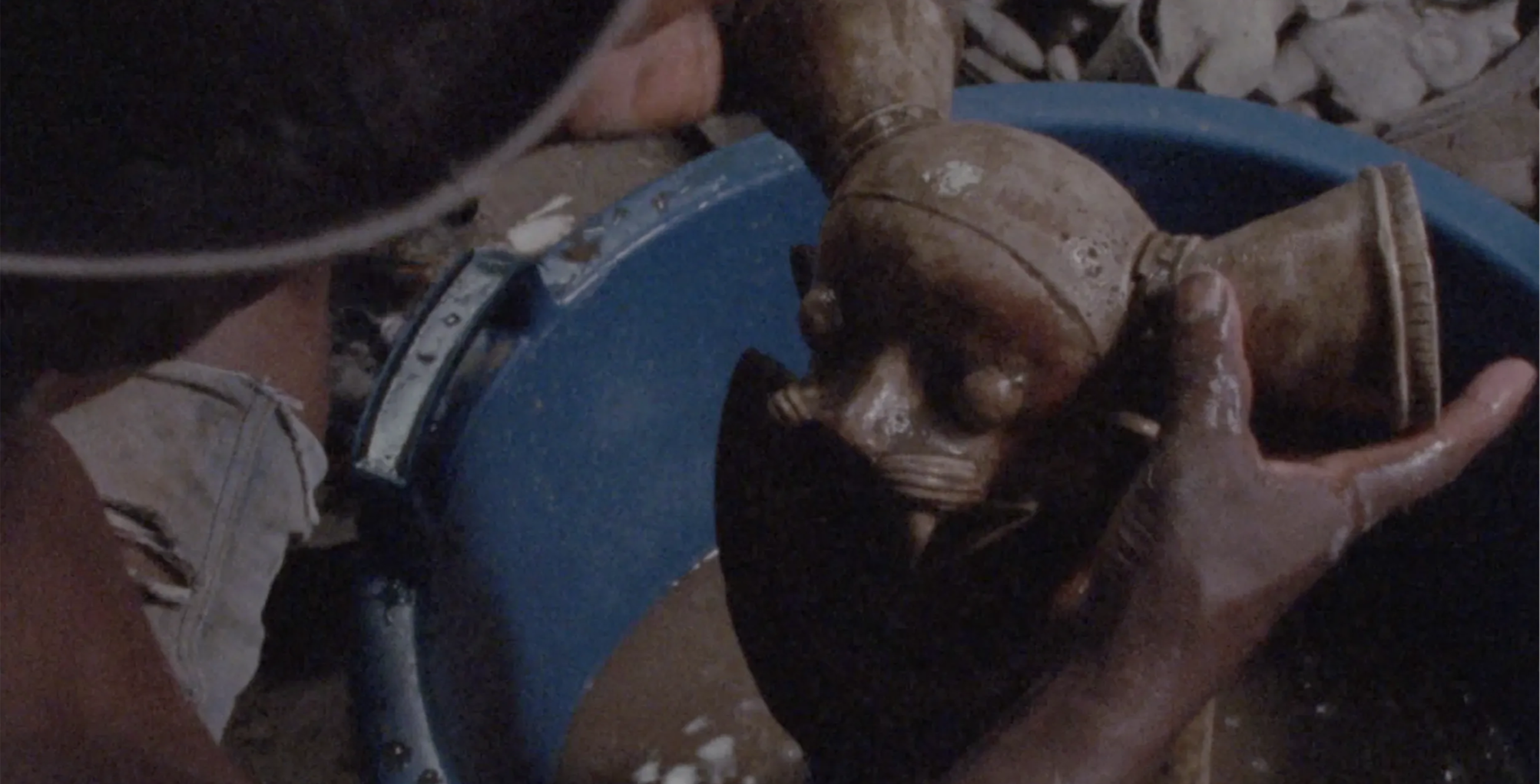
Huaquero by Juan Carlos Donoso Gómez
NHM: On that note of the fragment, I’m struck by your decision to frame hands, textures, and gestures rather than faces. Aside from the ethical necessity of protecting the identity of the huaqueros, how did you arrive at this focus on tactility and materiality?
JCDG: Protecting their identities was the initial, obvious threshold. Looting is classified as a heritage crime, and I was making this film while completing a Master’s in Latin American Studies, so I was hyper-aware of the ethical and legal implications.
But then a cinematic question emerged: What happens when you remove the portrait? In art, the portrait is a cornerstone of representation. What emerges in its absence?
I was incredibly fortunate to consult on the script with filmmaker Jessica Sarah Rinland, whose own work heavily inspires this film. We talked extensively about the "agency" of things and of nature. How can elements in the frame have just as much agency as a human body?
During my research, I read an American archaeologist’s work on how huacas were historically treated as living entities. They weren't passive; they gave counsel to community assemblies. People listened to them. I wanted to capture this concept of the "artifact persona."
Over ten years of researching this film, I also realized that the people looting these objects are just as fragmented as the pieces they dig up. No one gets rich doing this. There is a common saying in Peru that "the huacas are sad," and I felt a profound sadness in the bodies of the huaqueros themselves. They are performing these ancient rituals of excavation and search, but in a world where the sacred connection has been broken by colonial violence.
The people looting these objects are just as fragmented as the pieces they dig up... There is a common saying in Peru that 'the huacas are sad,' and I felt a profound sadness in the bodies of the huaqueros themselves.
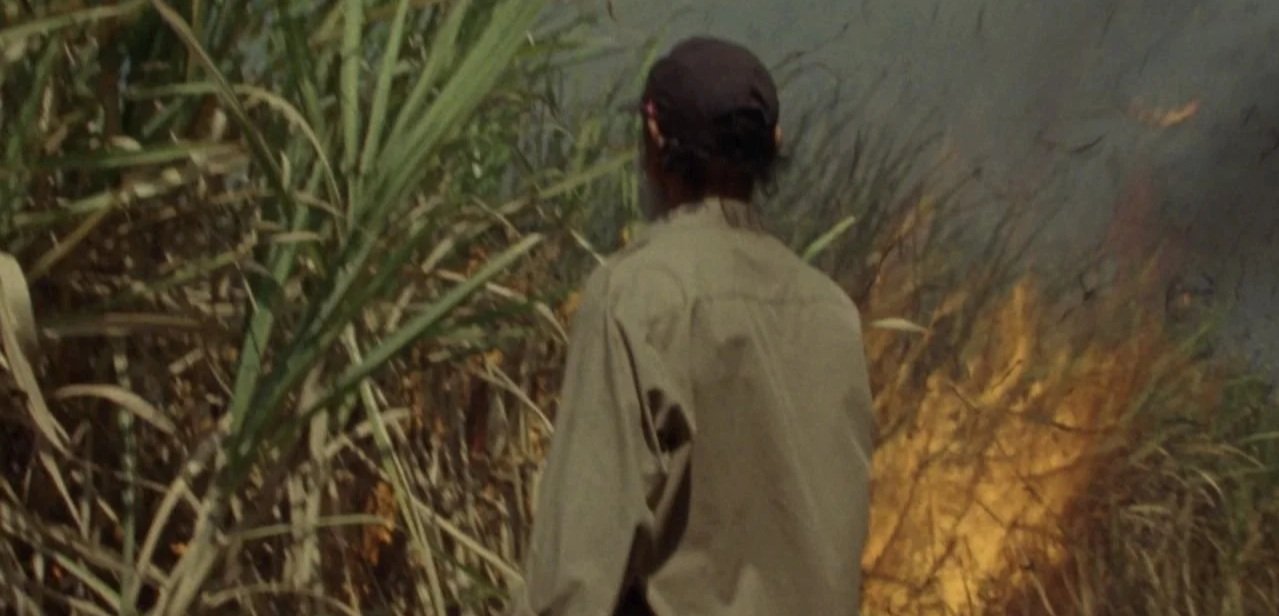
Huaquero by Juan Carlos Donoso Gómez
Audience Member: Could you talk about the role of the soil? It manifests in so many different textures and colors throughout the film.
JCDG: Soil in South America is essentially a archive. Whether in the Andes, the Amazon, or the coast, there are endless traces of culture physically mixed into the earth.
We filmed in three distinct regions. The first chapter is set in Esmeraldas, on the northern coast of Ecuador, near La Tolita—a region famous for being one of the first in the Americas to master platinum and gold alloys.
There is a scene where a character digs up a massive iron wheel. That wasn't scripted! He suggested we dig it, and we just rolled with it. It turned out to be a remnant of a 20th-century Italian businessman who was destroying archaeological sites to melt down ancient gold. So, the fragments in that soil aren't just pre-Columbian; they are modern ruins. They prove that colonialism is an ongoing process.
From there, we move to Peru, where the desert acts like a "fridge of time." Because it is so dry, it preserves everything, though the scale of looting there is staggering.
Finally, we go to Manabí in Ecuador, where my mother's family is from. The local communities there discovered ancient clay molds from the Valdivia culture—which produced some of the oldest pottery in the Americas, dating back 6,000 years. The locals began using these original molds to replicate ancient pieces, mastering antique techniques so perfectly that they can sell them as originals.
To capture all of this, we chose to shoot on 16mm. You’ll notice there are very few sky shots in the film. Ninety percent of the frame is focused downward, looking at the dirt. It was a conscious choice to dig into the earth with the camera.
Essentially, these were the Coastal Biomes explored in the film:
└── Tropical Rainforest (Esmeraldas, Ecuador)
└── Tropical Dry Forest (Manabí, Ecuador)
└── Coastal Desert (Trujillo / Lambayeque, Peru)
This geographical journey also represents a visual "drying out" of symbols, moving from lush green rain to barren desert sand.
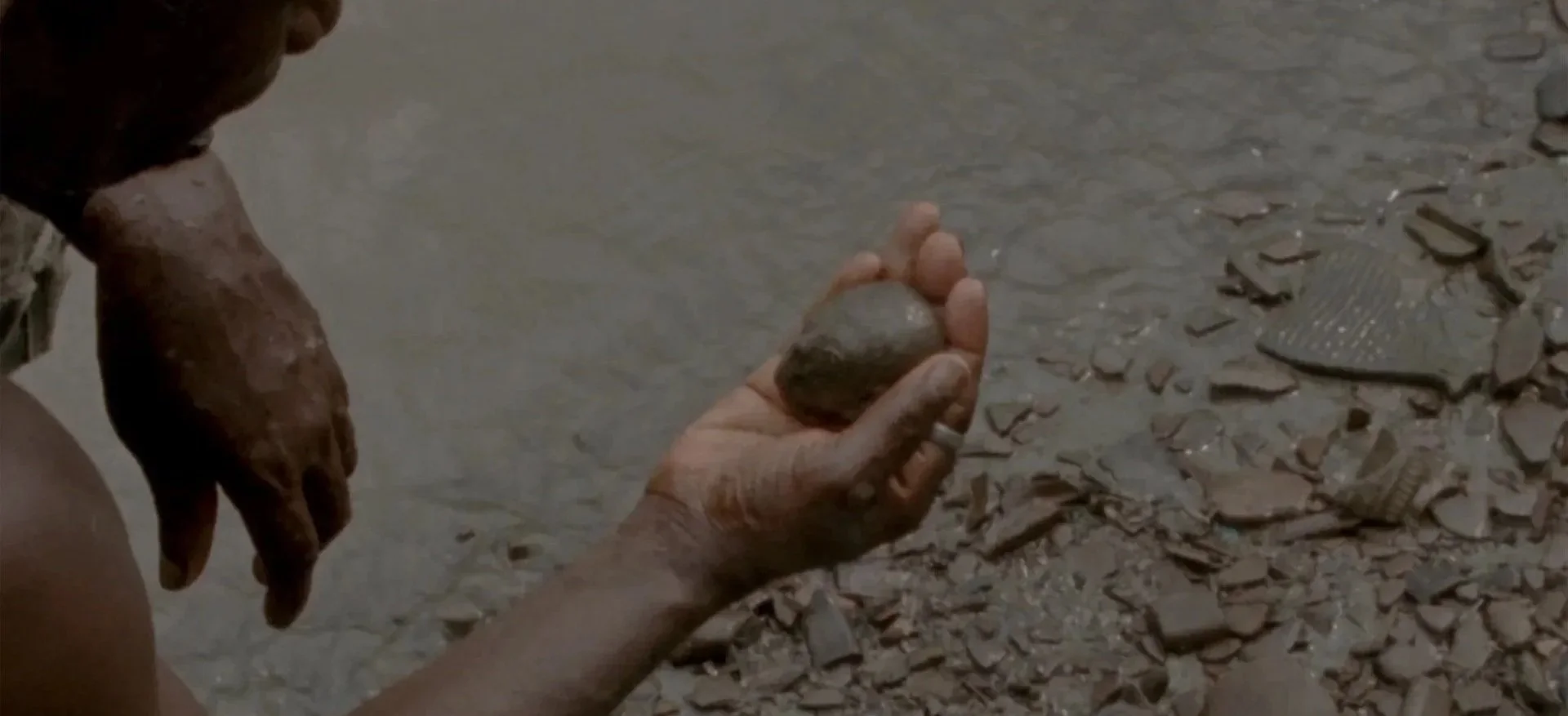
Huaquero by Juan Carlos Donoso Gómez
Audience Member: The huaqueros clearly possess an incredible, intimate knowledge of the land. At the same time, they operate in this gray market. What do you think can be done to better value their skills and integrate them into the preservation of this heritage?
JCDG: If you ask the huaqueros what they actually want, without exception, they will tell you: they want to be hired by official archaeological projects.
They have decades of experience. I worked with them for ten years, and they can look at a patch of ground and say, "The soil here is slightly more whitish, let's dig here," and boom—they find something. Their empirical knowledge is unmatched.
In Peru, there is a movement toward what is being called "New Peruvian Archaeology," which seeks a healthier relationship with local communities. Archaeologists like Walter Alva (famous for discovering the Lord of Sipán) started their projects under incredibly tense, hostile conditions with local looters. But over time, projects like Chan Chan (near Trujillo) and the Túcume project have started hiring locals.
It creates a vital cycle of shared knowledge. Instead of telling locals, "Get out, this is a protected site and you don't know anything," it empowers them as the true custodians of that memory.
These sites aren't just about beautiful gold museum pieces; they hold ancient scientific knowledge regarding water management, agriculture, and ecology. There is still so much to be retaken and relearned from the earth.