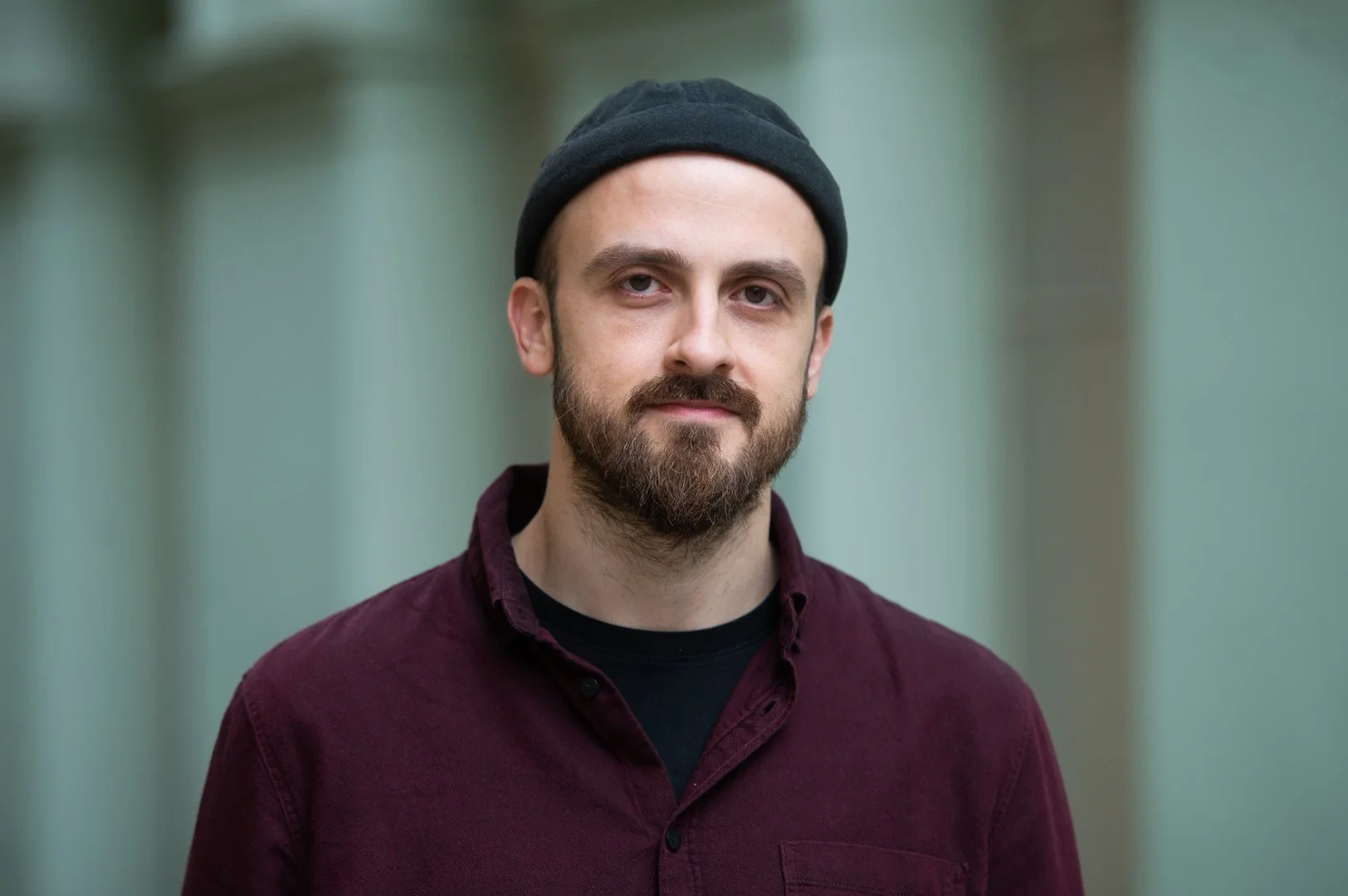
Director Davi Pretto. Photo credit: Film Servis Festival Karlovy Vary
By Guili Barki Minkovcius
Set in a bleak near-future Brazil where artificial intelligence has triggered a mysterious neurological crisis, Future Future follows K, a forty-year-old man who has lost both his memory and his sense of belonging. Drifting through a desolate, unnamed city shaped by deepening social inequality and technological control, he embarks on an absurd and increasingly tragic search for identity and connection.
Blending dystopian science fiction with political allegory, Pretto’s fourth feature offers a formally daring vision of a society collapsing under environmental catastrophe, class division, and the dehumanizing promises of technological progress. Incorporating AI into its own visual language, the film becomes a hypnotic and cautionary portrait of a world that feels both eerily distant and unsettlingly close.
After premiering internationally at the Karlovy Vary International Film Festival, Future Future went on to become the major winner of the 58th Festival de Brasília do Cinema Brasileiro, where it received awards for Best Feature Film, Best Screenplay, Best Editing, and a Special Mention for actor Zé Maria Pescador.
Ahead of the New York premiere of Future Future, I spoke with Brazilian filmmaker Davi Pretto about the making of his latest film and the ideas behind its unsettling vision of the near future.
In our conversation, Pretto reflects on the making of the film, the ways in which reality unexpectedly shaped its course, and his use of AI as both a subject and a cinematic tool. He also speaks about the film’s ambiguities, its dialogue with audiences, and what cinema can offer as a space for reflection in a time of profound social and technological uncertainty.
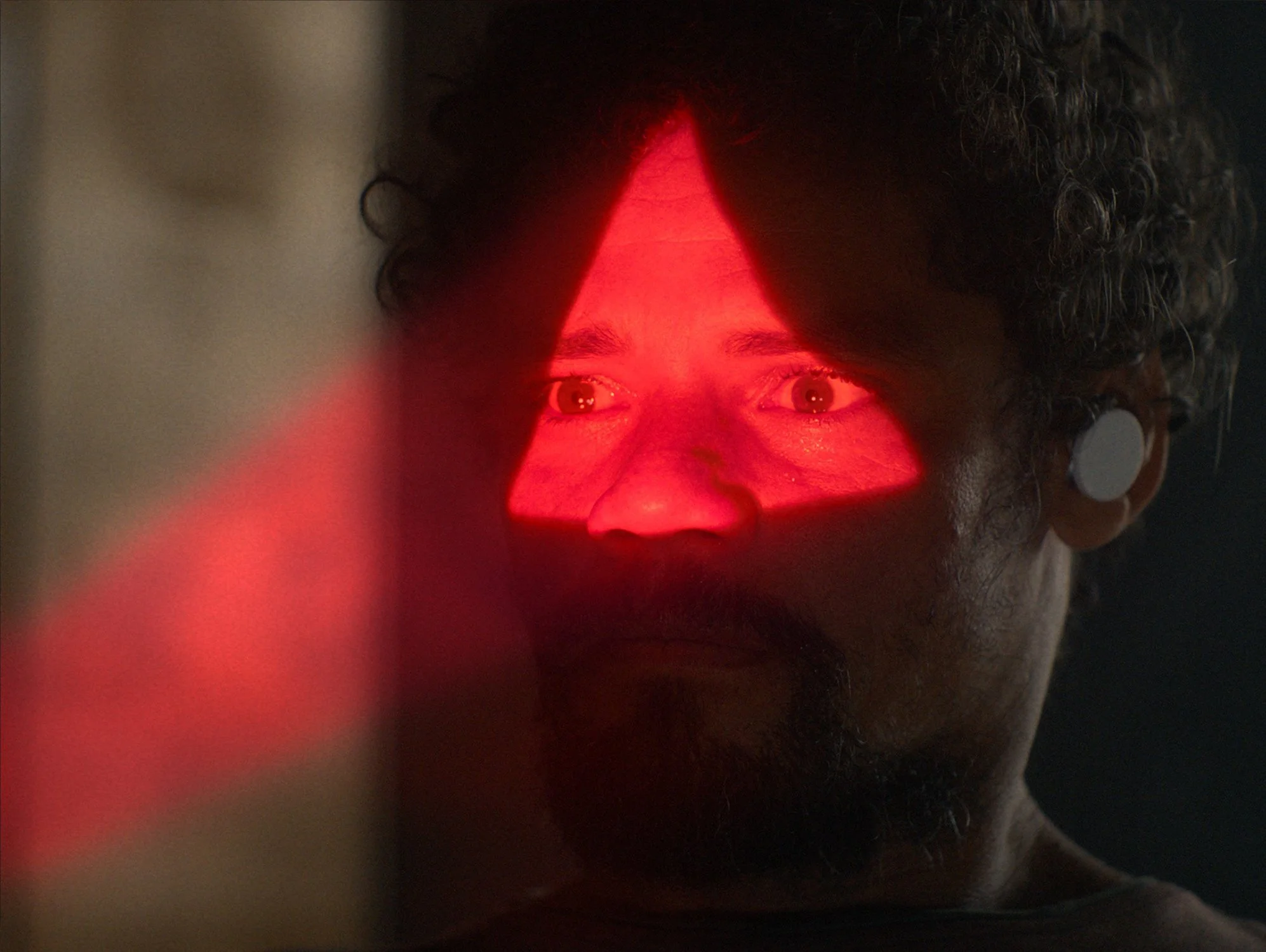
I wanted to start by asking about the beginning of the film. It opens with a title card stating that it was shot before and after the historic floods. Could you talk a little about the creative process? The film is a dystopian story where water is already such a central element. What came first, and how did the film change after the floods?
Davi Pretto: The flood was already part of the story and the screenplay. From the beginning, there was this idea of talking about a world in a permanent state of crisis. So, naturally, it was also a film about the climate crisis, in addition to all the other crises the film touches on.
In 2023, when I was in the final stages of the screenplay and we had locations lined up for filming, there was a major flood in Porto Alegre. The city was heavily affected, though nowhere near the scale of the 2024 flood. That experience, while I was writing a film about this very subject, gave me the certainty that it needed to be part of the story.
So the entire plot point about the school being evacuated to serve as a shelter at the end of the film was already in the script. In fact, the scene where K is leaving and the teacher tells him that the school is going to become a shelter was shot on our very first day of filming.
Then, it rained continuously for the three weeks we shot. We didn’t even need to use the rain machine we had planned.
Shortly after, the catastrophic flood hit Porto Alegre. On the third-to-last day of shooting, we were in the Historic Center of Porto Alegre—precisely the area the city government evacuated. Everyone had to leave: residents and workers alike, without knowing when they would be able to return.
We had to stop shooting that day—it was May 13, 2024. For three months, all our equipment, including cameras, remained trapped at that location. We were only able to return to filming three months later.
It was a tragic coincidence: a film about a dystopia and a flood suddenly confronting that exact reality. We didn’t film anything during the peak of the flood, though. The city was in a completely chaotic state, and it would have felt obscene for us to document what was happening, given the indescribable magnitude of the social catastrophe.
When you returned, you only had three days left of shooting. Did that three-month interruption alter the screenplay in any way?
We only had those three days left, primarily because our budget was R$1 million—around $200,000—which is extremely low by Brazilian standards. Because of the flood and the interruption, we had to recreate many elements. We had to restart pre-production to resume shooting, which was costly. We also had to bring back cast members who lived outside Porto Alegre.
The financial strain was enormous. In fact, the interruption caused by the flood was what pushed the film to lean even further into its AI elements. AI was already in the screenplay, but originally, it was meant to be used sparingly, primarily in K’s dream sequences.
However, some of the locations we still needed to shoot had been destroyed. One of them was the private luxury neighborhood—which was actually an industrial complex we transformed to look like a luxury gated community, since the real luxury neighborhood wouldn't allow us to film there, for obvious reasons.
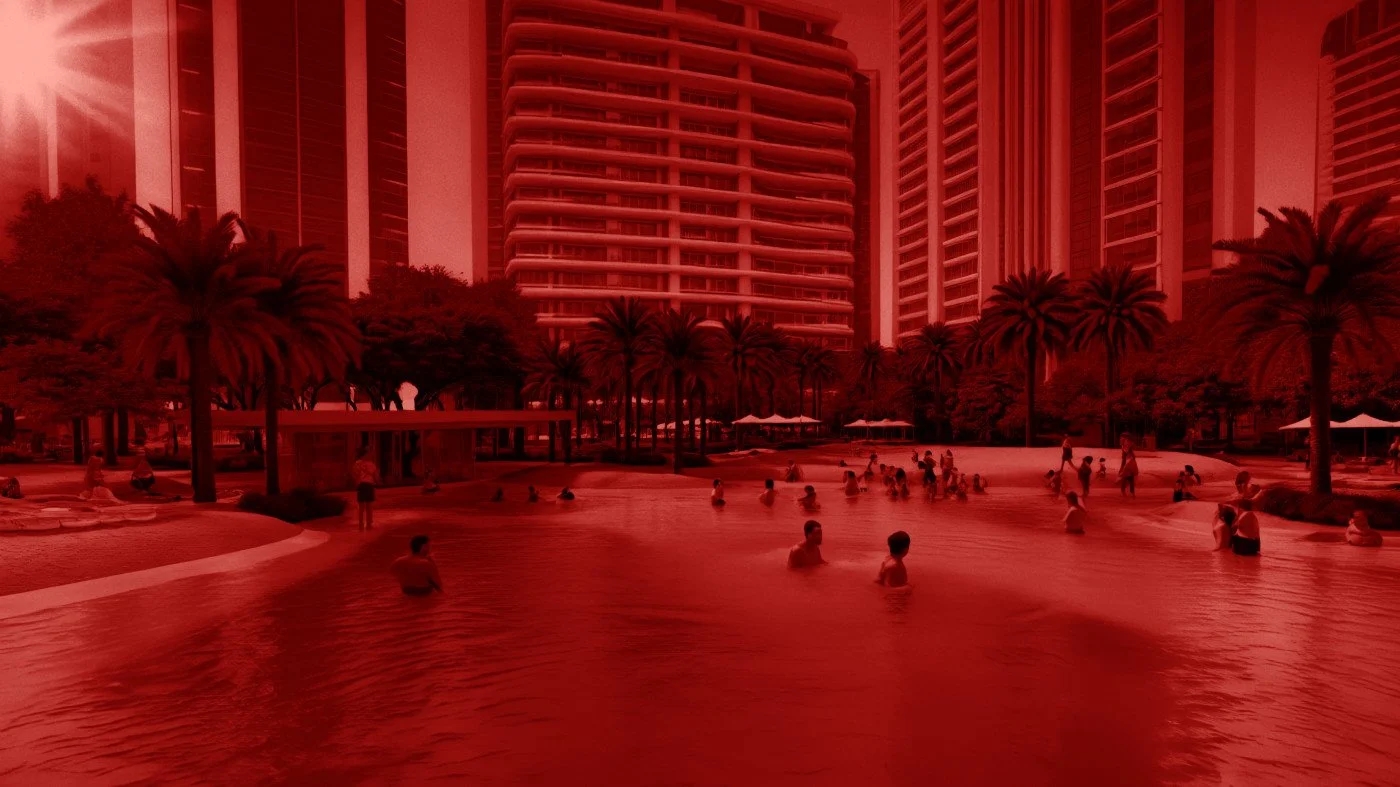
Having lost the location that was hardest to secure, AI became our way of finishing those scenes. We already had some footage, but not everything we needed, so using AI created this explicitly artificial universe for the condominium within the film. That was something we hadn't originally planned.
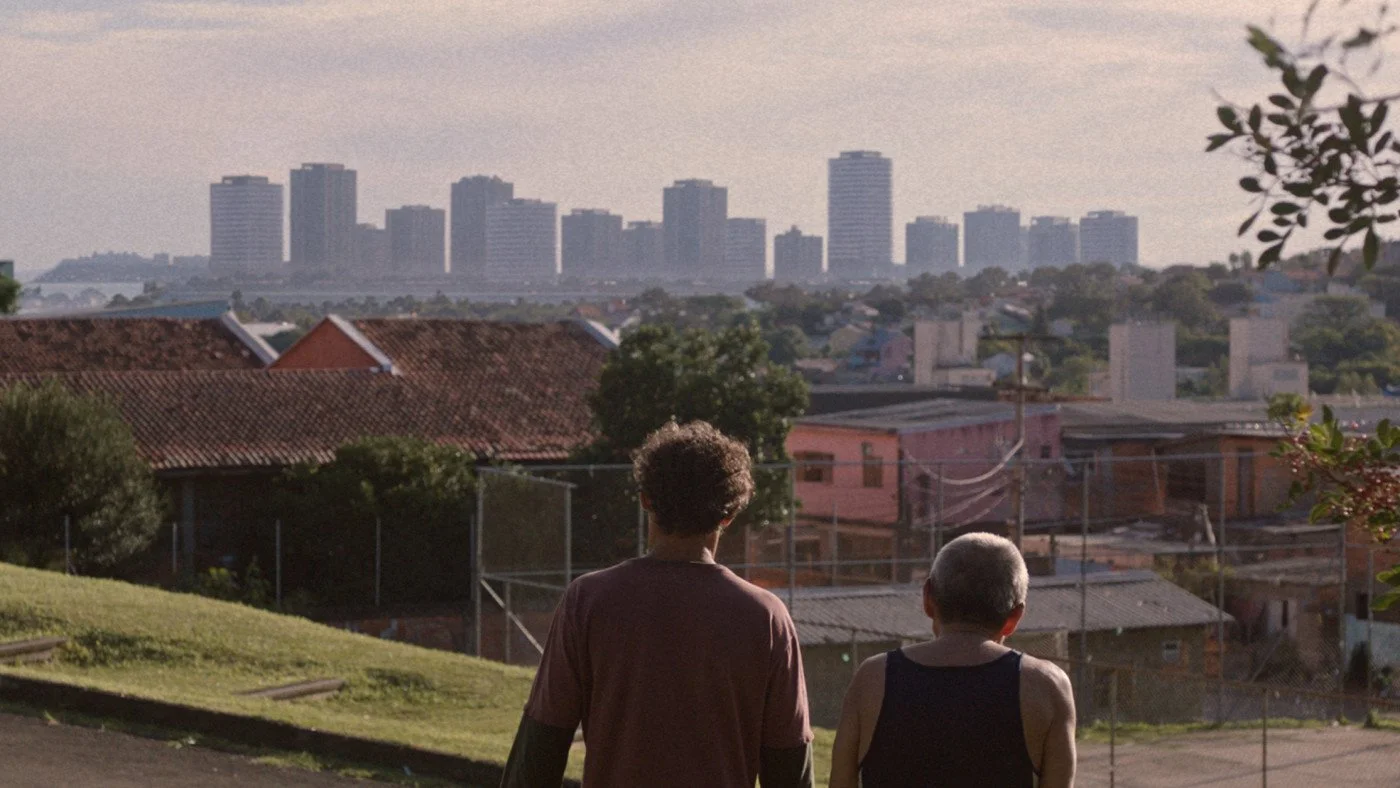
Future Future by Davi Pretto
The film mixes psychological drama with collective, climatic and social collapse. It reminded me of the films from Adirley Queirós. What were your references when you were making the film?
I think Adirley’s films certainly echo in ours. We shared the same cinematographer, Léo Feliciano, so there's that connection through Léo’s eye and his perspective on independent cinema and dystopia.
Curiously, the film had relatively few direct cinematic references. One key reference was a film by Gakuryū Ishii that I really admire, August in the Water (1995). It borders on the supernatural, and that space between the real and the surreal is something I love.
There were also influences from Kiyoshi Kurosawa, particularly Pulse. I’ve always been fascinated by Japanese cinema from that era, especially that generation around Kurosawa, because they made small, deeply unsettling films.
However, my primary references came from literature: Ursula K. Le Guin, Octavia Butler, William Gibson, and Philip K. Dick. Reading their work helped me conceive a vision of Brazilian science fiction that didn't simply replicate North American tropes.
How did you assemble the cast, and what was the collaborative process like with them?
I had seen Zé Maria lead in a film by Guto Parente called The Cannibal Club, and I was deeply impressed by his work. I’d also seen him in films by Marcelo Gomes and Renata Pinheiro.
As for Clara, Higor Campagnaro, and Carlota Joaquina, they were all actors I had admired in films outside Porto Alegre. I wanted to create an unnamed city populated by people from various regions.
It was the first film where I truly opened myself up to working with actors from elsewhere. With Castanha, of course, our relationship dates back to my first short film, Quarto de Espera, which I co-directed with Bruno Carbone, and then Castanha, my first feature. I’ve known Castanha for a long time. What we share is a deep appreciation for these individuals and their onscreen presence.
Regarding my directing style, I’ve developed a somewhat unconventional method through working with many non-professional actors on Castanha and Rifle. I always handle the cast preparation myself. My approach doesn't involve heavy rehearsal of the script itself. Instead, it relies on conversation and experimentation. When we do rehearse, we often work on scenes that aren't in the film—exercises designed purely to build the world and relationships.
The key difference with Future Future was our tight production timeline—we shot in just 15 or 16 days, making it the shortest feature shoot I’ve ever done. That required a bit more scene preparation, but we kept it minimal so we could remain agile on set.
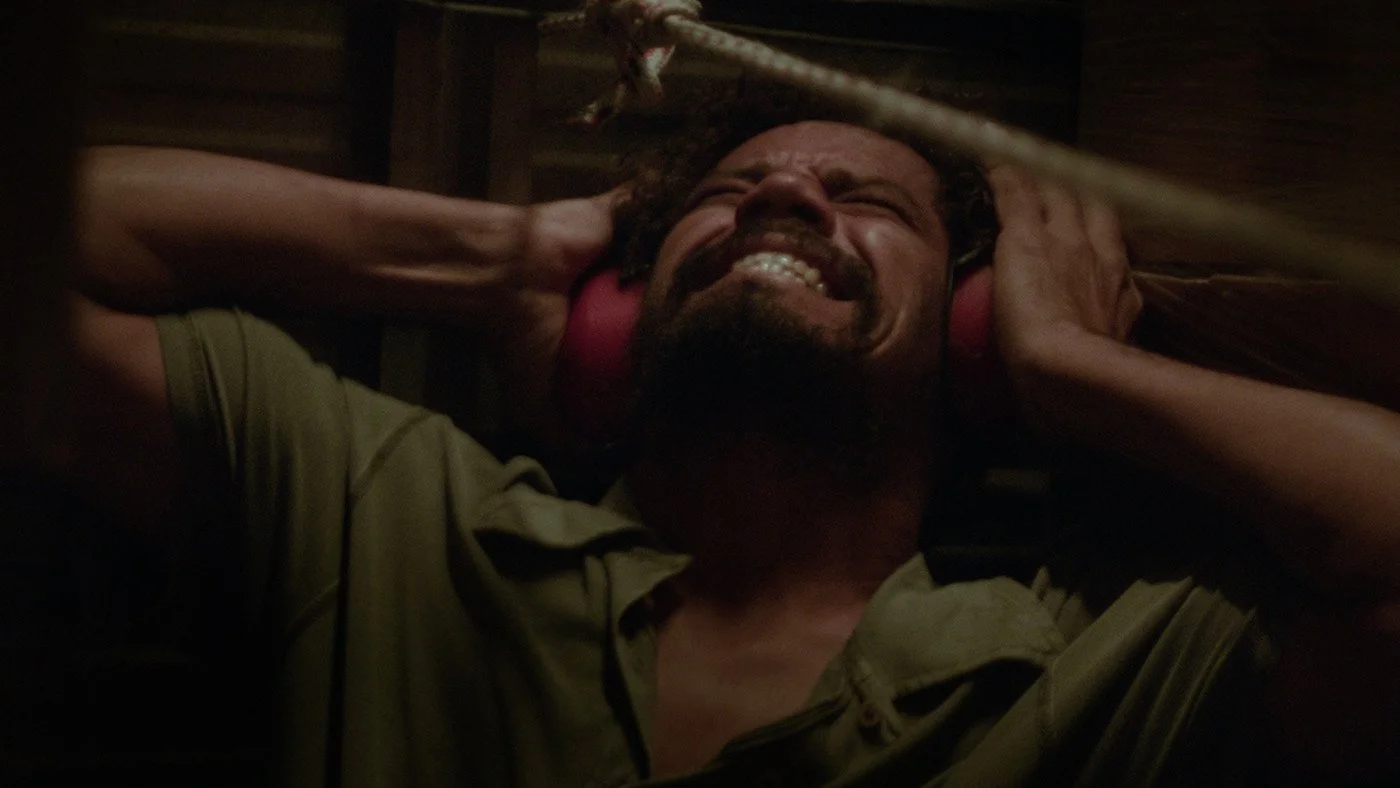
José Maria Pescador in Davi Pretto’s Future Future.
The film balances explicit themes—the divide between the wealthy and the rest of society, the precarity of labor—with elements left opaque or ambiguous. How did you approach that balance? Was that ambiguity intentional from the start, or did it emerge in editing?
There was something specific about this film: how to construct a character’s journey in which, at some point, it becomes clear that his journey, his search, is being heavily driven by external conditioning.
His own desire to go somewhere is eventually revealed to be something that has actually been induced in him.
So this is precisely a break from a more classical screenwriting paradigm, in which the character wants what they want. We’re accustomed to narratives in which the character has a tragic flaw, a need, some kind of lack, and then has an objective—and that objective belongs to them.
In this film, it’s exactly the opposite.
So I think there was a deliberate attempt to create a narrative that functioned as a kind of pretext, with that pretext becoming a surface on which the things you’re talking about could be made explicit. The symbols become anchors for this induced movement, for this character who wanders through the world almost like a ghost, being carried along by external forces—which is precisely what every screenwriting manual tells you not to do.
It was almost like an experiment: an experiment in inhabiting this world of science fiction with a deliberately erratic or strange narrative.
And I think the film’s most delicate balance was deciding what to reveal and what not to reveal. We knew we would need certain concepts to function almost like buoys, so that the viewer could make it through the journey without simply drowning in the process.
There is this mystery surrounding the disease that many people don’t understand in the film. But those mysteries are precisely what invite people to think about what these elements mean and about what exists between these more explicit elements.
For example, what is the relationship between the division of the city and amnesia? What is the relationship between those two elements in the world we live in? They’re like symbols. I think the film works with these symbols. Some are given to viewers so they can grasp them, while the rest are parts of a web that people can connect—or immerse themselves in—if they want to.
The film embraces AI’s imperfections, with human bodies becoming strange shapes and forms, instead of trying to simulate reality. Was that always intentional, or did you discover it through experimentation?
That was always the idea. What always interested me about AI was the hallucination it generates—the thing they call AI hallucination, when the AI makes mistakes in audio and images.
And that hallucination generates an aesthetic that people call “AI slop”—this kind of tackiness, this trashy AI aesthetic. It’s already part of what we consume every day, on social media and even on television. I wanted the film to expose it so that people would have time to look at it.
Because for me, it’s completely connected to the character’s own delirium, to the nightmare generated within the story, and also to the way we’re living in a reality transformed by these images.
We’ve always had a concept of reality that was deeply connected to the kinds of images we consumed. Since the beginning of photography, images had a relationship with the real. Today, these machine-generated images have no connection to reality. So the very concept of reality that we share has been transformed by these images that tell us what reality is. There’s something about that that I find very frightening.
For me, it was important to give these images time. At the time, these images were only capable of lasting two or three seconds, and I found a thousand ways to make them last ten or fifteen seconds, as long as possible, so that you could really see the idea.
And I think that was always important: that AI not be made invisible in the film, that it not be diluted into the narrative in an attempt to make it look real. The film is exposing it, including in a critical way.
It’s a risky gesture, but at a certain point I realized that I needed to make it. I didn’t have another way of doing it.
Future Future by Davi Pretto
The film has screened at several festivals, won major awards in Brasília, and has now opened commercially in Brazil. How have audiences reacted, and what has surprised you most?
I think every screening is a screening of its own. Every screening is different.
In many ways, festival audiences now closely resemble the audiences who still go to independent theaters for Brazilian cinema. The commercial distribution landscape has become increasingly difficult; an independent Brazilian film without a massive promotional budget might only last a week in theaters before disappearing. That is no longer just a challenge for Brazilian cinema, but a broader crisis in global film culture.
But I think one thing is certain: the strangeness of the film, which was deliberately meant to provoke and affect people, does affect them. Some people like the film, some people hate it. We knew that would happen. But the main thing is that the film has generated a lot of conversation.
Q&A sessions have been remarkably long. Audiences stay to ask detailed questions because the film addresses anxieties they are actively experiencing. People see the film as a catalyst for conversation. Even those who were challenged by it want to engage, listen, and debate.
And I find that gratifying because that was one of the ideas behind it. Obviously, we make films for many reasons, but I also think of the film as a portal for discussion. And I think the film has generated that. That makes me happy.
Future Future will have its New York premiere on Wednesday, August 19, at 7pm at Anthology Film Archives in New York City, as part of Lost & Found: cine(ma)s latinoamericanos re-unidos—Anthology Film Archives and Cinema Tropical’s monthly screening series dedicated to rediscovering and recontextualizing Latin American cinema.
Tickets and more information are available here.