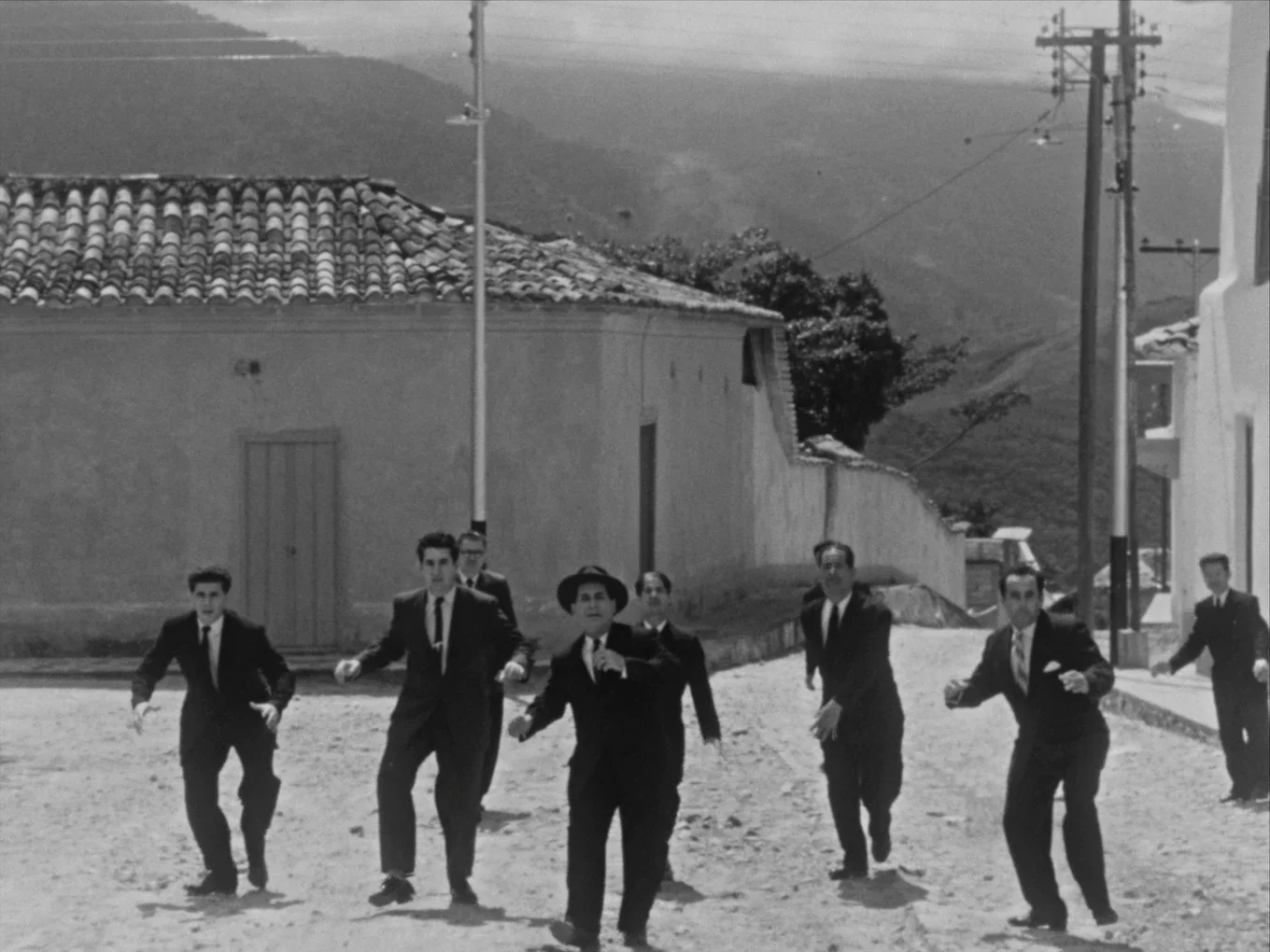
LA PAGA
(Ciro Durán, Colombia/Venezuela, 1962, 62 min. In Spanish with English subtitles)
With Alberto Alvarez, María Escalona, Luis Márquez Páez, Paco De la Riera.
North American restoration premiere
Ciro Durán’s La Paga is an important rediscovery, banned in 1963 by the Venezuelan government after a single screening in Caracas—the 23-year-old Colombian writer-director would be jailed for his union activism soon after—and only resurfacing some 60 years later at its “world premiere” at Cannes in 2025. Presented in association with Cinema Tropical, a New York–based nonprofit dedicated to promoting Latin American cinema, La Paga is the stark, nearly abstract vision of a peasant in the Colombian-Venezuelan Andes who rebels violently against the exploitation that keeps him and his family both indentured and impoverished. With a pregnant wife and a son in desperate need of medication, the man sees only one way out. Durán self-produced La Paga only a few years after the Cuban Revolution inspired him to relocate from a traditional Catholic village in Colombia to the vibrant cultural scene of Caracas. The film draws on Durán’s own childhood experiences and was influenced by Soviet montage and Italian Neorealism.
Restored in 4K in 2025 by Joyce Ventura, Maleza Cine, and the Colombian Film Heritage Foundation - Fundación Patrimonio Fílmico Colombiano, under the general coordination of Vladimir Durán, in collaboration with the Cinemateca de Bogotá, with the support of the Colombian Film Development Fund - Fondo para el Desarrollo Cinematográfico de Colombia, using the original 35mm internegatives preserved by the Fundación Cinemateca Nacional de Venezuela.
ON THE EMPTY BALCONY / EN EL BALCÓN VACÍO
(Jomí García Ascot, Mexico, 1962, 57 min. In Spanish with English subtitles)
With Nuri Pereña, María Luisa Elío, Conchita Genovés, Belina García.
U.S. restoration premiere
Gabriel García Márquez dedicated his epic novel One Hundred Years of Solitude to Jomí García Ascot and María Luisa Elío. Who were they? Ascot and Elío belonged to a generation of exiles who fled the Spanish Civil War and ended up in Mexico in 1939. In her poetic and haunting writings, Elío described her journey as a child refugee of war and dictatorship who found herself trapped in the traumas of her past, and this formed the basis for their deeply personal film collaboration, On the Empty Balcony. Shot on 16mm over the course of two years, with a skeletal crew of friends—but only on Sundays because they all had paying jobs on weekdays—the film was considered a manifesto of the Grupo Nuevo Cine (New Cinema Group): filmmakers who were inspired by the Spanish director Luis Buñuel and the Mexican poet Octavio Paz; took part in the artistic ferment of artists, intellectuals, and activists before and after the war; and worked outside the commercial mainstream yet had critical success in festivals abroad. On the Empty Balcony ushered in a new wave of independent and more experimental filmmaking in 1960s Mexico, a country that had just experienced its so-called Golden Age of wildly popular melodramas, musicals, and noir thrillers but threatened to grow stale in the face of social and political repression. The film first screened at a cine-club in Mexico City and then won a prize at Locarno before disappearing for decades, its reputation largely known through bootleg videos and occasional clandestine presentations. Now, thanks to the magnificent restoration work of the Elías Querejeta Zine Eskola and UNAM, the film reasserts its place in the history of Mexican cinema.
Restored in 2K in 2025 by Elías Querejeta Zine Eskola in collaboration with Filmoteca de la UNAM and TV UNAM at Elías Querejeta Zine Eskola laboratory, from the 16mm combined dupe negatives preserved by Filmoteca de la UNAM. Funding provided by Elías Querejeta Zine Eskola, the Government of Navarre, and Luis Alberto Juárez Pineda.
Tuesday, January 20, 7pm and Monday, January 26, 4pm
The Museum of Modern Art
11 West 53rd Street, New York City
Tickets and more information: https://www.moma.org/