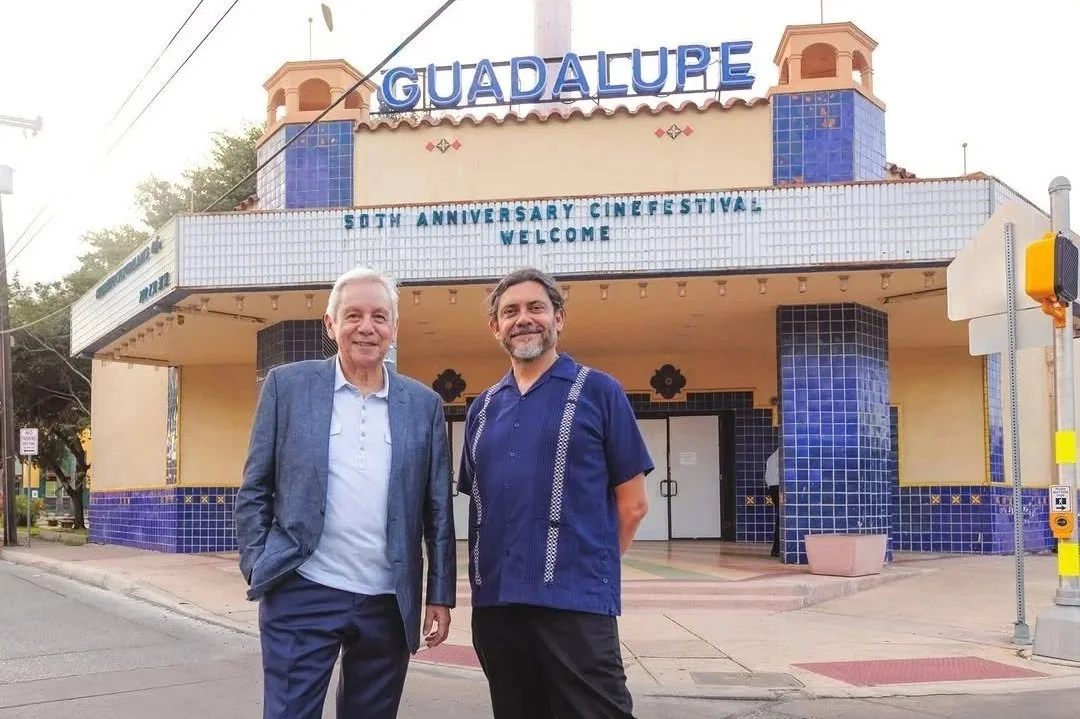
CineFestival founder Adán Medrano and current director Eugenio del Bosque
This year marks a major milestone in U.S. Latinx film history: the 50th anniversary of the founding of the San Antonio CineFestival, the nation's longest-running Latino film festival and the first of its kind in the United States.
Founded in 1976 by filmmaker, food writer, and cultural advocate Adán Medrano under the name Chicano Film Festival, the event emerged at a time when opportunities for Chicano and Latino filmmakers to exhibit their work were exceedingly scarce. Medrano recognized that a new generation of filmmakers across the country was creating stories rooted in local communities and lived experiences that deserved to be seen on their own terms.
Now stewarded by the Guadalupe Cultural Arts Center and under the direction of Eugenio del Bosque, the San Antonio CineFestival returns for its 47th edition on July 9–12, 2026.
The festival's beginnings have become part of Latinx film lore: a 16mm projector hoisted into a tree, white bedsheets serving as a screen, and an empty lot at San Antonio's Oblate School of Theology transformed into an outdoor cinema. Over two evenings in August 1976, an estimated 2,500 people gathered to watch films that reflected histories, experiences, and perspectives largely absent from mainstream American screens.
The inaugural program featured works by filmmakers who would become foundational figures in Chicano cinema, including Moctezuma Esparza, Luis Valdez, Severo Perez, David Garcia, Tony Bruni, Carlos Calbillo, and Medrano himself. The overwhelming community response demonstrated both the vitality of the emerging movement and the urgent need for spaces dedicated to these stories.
The festival evolved rapidly from a grassroots initiative into a citywide effort supported by schools, churches, businesses, community organizations, and local media. In 1980, it adopted the name San Antonio CineFestival, further cementing its connection to the city that nurtured it.
A year later, Medrano transferred the festival to the stewardship of the Guadalupe Cultural Arts Center, a decision that helped secure its long-term future and embed it within one of the country's leading Latino cultural institutions.
Over the decades, the festival expanded its vision to include a broader range of voices and perspectives, including a deliberate effort to champion women filmmakers and address historical gaps in representation within independent and Chicano cinema.
Today, the San Antonio CineFestival stands as a cornerstone of Latinx film culture in the United States. Long before diversity and representation became industry watchwords, the festival was creating audiences for Latino cinema, fostering new talent, and proving that community-based film exhibition could reshape the cultural landscape.
Fifty years after a projector was lifted into a tree and films flickered across bedsheets in a vacant lot, the founding vision of the San Antonio CineFestival continues to resonate: that stories born from specific communities can speak to universal experiences, and that cinema can serve as both cultural memory and collective imagination.