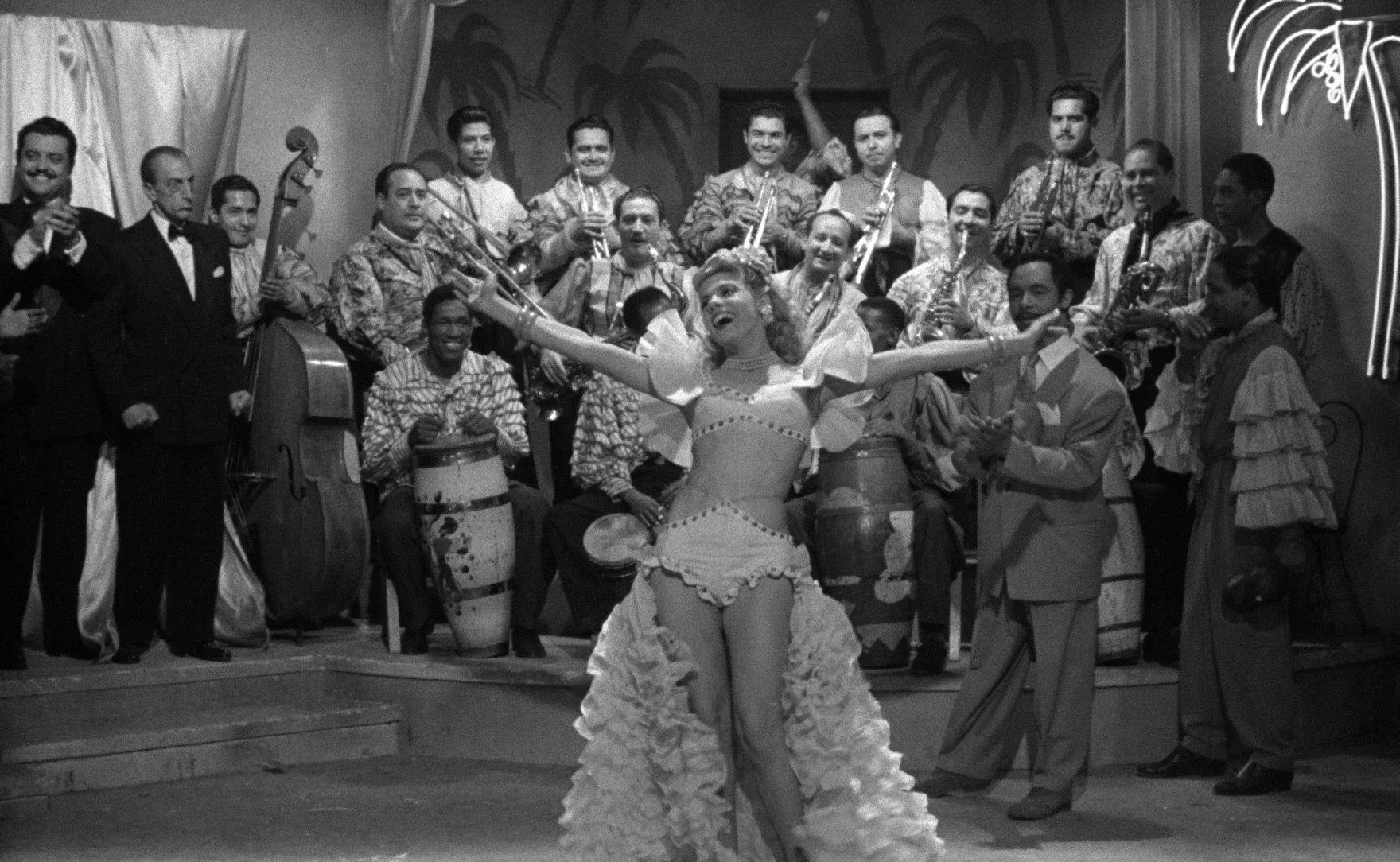
Victims of Sin by Emilio Fernández
One of the most magnetic stars of Mexican cinema’s Golden Age is taking center stage next month on The Criterion Channel. A new four-film retrospective celebrates the extraordinary career of Cuban-born actress, dancer, and choreographer Ninón Sevilla, the undisputed queen of the cine de rumberas.
Emerging in the 1940s and reaching the height of her fame in the following decade, Sevilla became the defining face of a uniquely Mexican genre that blended melodrama, film noir, and musical spectacle. With her electrifying screen presence and innovative Afro-Cuban dance numbers—many of which she choreographed herself—she embodied women navigating worlds of desire, betrayal, redemption, and survival.
The program brings together four essential films from her remarkable career: Carita de cielo (1947), Aventurera (1950), Victims of Sin / Víctimas del pecado (1951), and Take Me in Your Arms / Llévame en tus brazos (1954). Among them are two of the most celebrated works of the era, Aventurera and Victims of Sin, masterpieces that showcase Sevilla at the height of her artistic powers and remain touchstones of Mexican popular cinema.
One of Sevilla’s earliest starring vehicles, Carita de cielo helped establish the persona that would make her a sensation throughout Latin America. Directed by José Díaz Morales and starring María Elena Marqués, Antonio Badú, and Fernando Soto, the film showcases Sevilla’s charisma and athletic dancing while foreshadowing the complex, emotionally charged characters she would later perfect. Though lighter in tone than her subsequent classics, it offers a fascinating glimpse of a star in the making.
Widely regarded as the crowning achievement of the rumberas genre, Aventurera stars Sevilla as Elena, a young woman whose life is shattered after a family tragedy leaves her vulnerable to exploitation. Directed by the great Alberto Gout and also starring Andrea Palma, Tito Junco, Rubén Rojo, and Miguel Inclán, the over-the-top film combines feverish melodrama, dazzling musical sequences, and sharp social critique into one of the most beloved works of Mexican cinema. Sevilla’s fierce and emotionally charged performance anchors a film that has only grown in stature over the decades and is now considered a masterpiece of Latin American popular culture.
If Aventurera represents the genre at its most iconic, Emilio Fernández’s Victims of Sin may be its most visually stunning expression. Sevilla plays Violeta, a cabaret dancer who rescues an abandoned baby and embarks on a relentless struggle to protect him. Shot by legendary cinematographer Gabriel Figueroa, the film transforms melodrama into something almost mythic, while Sevilla delivers one of the defining performances of her career. The result is a powerful fusion of maternal sacrifice, urban noir, and exuberant musical spectacle.
Directed and co-written by Julio Bracho, one of the most sophisticated filmmakers of Mexico’s Golden Age, Take Me in Your Arms offers a striking variation on the rumberas formula. Sevilla stars as Rita, the daughter of a poor fisherman from a small village in Veracruz who leaves home to help settle her father’s debts, only to find herself exploited by a succession of powerful men, including a married politician who transforms her into a celebrated dancing star.
Directed by Julio Bracho and also photographed by Figueroa, Take Me in Your Arms stars Sevilla as Rita, the daughter of a poor fisherman who leaves her small Veracruz village to help pay her father’s debts, only to become entangled in a world of exploitation, ambition, and desire. Blending social melodrama, class tensions, and spectacular musical numbers, the film showcases Sevilla’s extraordinary screen presence while offering one of the most visually elegant entries in the rumberas genre.
Bursting with passion, music, and unforgettable performances, these films offer a perfect introduction to an artist whose influence continues to resonate across Latin American cinema.