By Loira Limbal, President and CEO, Firelight Media
On February 8, more than 100 million people watched Benito Antonio Martínez Ocasio—Bad Bunny—perform at the Super Bowl halftime show. I woke up early the following morning to watch the replay before taking my kids to school, and I was immediately captivated by the set design, the dancers, and the songs. A wave of pride worked its way up from my stomach to my chest. Then it turned to tears at the sight of a Black woman in her 50s or 60s dancing to Benito’s “Baile Inolvidable.”
Memories I hadn’t summoned rushed to the surface: tías playing bingo in Harlem parks with rum flowing and bachata blasting; my mother mesmerizing rooms with her dancing at baby showers in Washington Heights; the impatient adults at city agencies frustrated that they had to communicate through me, a six-year-old, because my mother didn’t speak English.
Benito put a Puerto Rican flag on the biggest stage in American entertainment. That matters. In an inhumane world, sustenance comes in many forms—pop culture and nonfiction cinema exist on the same media spectrum, and for those of us most harmed by these forms of representation—or lack thereof —both are essential. Since the pandemic, whenever Benito does anything, the whole archipelago of Puerto Rico stops to watch. That is sustenance. It feeds something in us that the U.S. has tried to starve.
But the lives underneath these major pop culture moments—my mother’s humiliation, her power, the daily choreography of survival in a country that has never valued her—those require a different form. They demand the honesty, intimacy, and care that nonfiction cinema excels at.
I was eleven when I overheard my mother talking to my great-aunt. “Two bus drivers slammed the door in my face,” she said. The third slowed down long enough for her to explain that her daughter had gotten into a good magnet school in Manhattan, but we lived in the Bronx. She only had bus fare one way. The driver rolled his eyes but waved her on. I picture those doors slamming shut to this day. My mother, who raised us working twelve-hour shifts, couldn’t afford bus fare. The humiliation she endured still hurts.
My artistic practice is fueled by that pain and by a profound love for my mother, and for all those who have experienced the everyday violence of a deeply violent country. Violence made invisible by its ubiquity. The kind not attended to by establishment Democrats or Republicans. The kind that is deadly but never makes it into a true crime documentary.
I was raised by an extraordinary cast of Black and Latina women who performed daily miracles of resilience, creativity, and subversion. In our popular culture, these women are rarely seen—and when they do appear, they’re reduced to caricatures. My vision as a filmmaker is to flood our culture with beautifully complex portrayals of working-class women of color. Nonfiction cinema is a mirror, an offering, a sword, a balm. It is sustenance.
As President and CEO of Firelight Media, I lead an organization dedicated to nonfiction cinema by, about, and for communities of color. I stepped into this role in a hostile moment because I know the project we are engaged in is one of truth and reparation. We are building a counter-archive—a record of life in the United States that certain people would prefer didn’t exist, while the people who lived it are still here to tell it.
Independent nonfiction cinema is facing a battle on every front: the defunding of public media, AI-fabricated footage, censorship, and commercial platforms’ abandonment of authentic storytelling. This is not a crisis of funding alone. It is a battle for the nation’s imagination—for who gets to shape how communities see themselves and remember their histories.
In the latest presidential election, half the country voted the way it did because this is a society that has never fully reckoned with its violent genesis. After you adjust for inflation, The Birth of a Nation remains the highest-grossing film in American history. For 250 years, this country has been telling itself a story, and the most popular version has always been the white supremacist one. In a country founded on the genocide of Native Americans and the enslavement of Africans, racial justice is not an add-on—it is the core of any real attempt to build the multiracial democracy the U.S. claims to be.
This society has agreed that some lives matter more than others and that the market will somehow fix it all. Imagine if the so-called racial reckoning of 2020 had gone beyond solidarity statements and DEI checkboxes. Imagine if we had listened to generations of Black folks saying that an increasingly militarized law enforcement force was terrorizing us and our children, and that if they continued to act with impunity, they would eventually terrorize everyone. I imagine that Keith Porter, Renee Good, and Alex Pretti—all killed by ICE agents—would still be alive. That five-year-old Liam Conejo Ramos would not have been seized in a Minnesota driveway and sent to a detention center in Texas.
The institutions that decide which stories get funded and seen still treat filmmakers of color as afterthoughts. They say our stories don’t have audiences, aren’t artful enough, don’t resonate internationally—too woke, too alienating. But in our push for inclusion, how much of their logic did we absorb? How much of their value system did we mistake for our own? This is a moment to reject it—to refuse their metrics, their gatekeeping, their terms—and reclaim the radical heart of our work.
For decades, we conceded too much, following audiences, prestige, and promises of money—even as stories shrank to the size of our palms and tech platforms hijacked our attention. What if the cultural project we need demands the very opposite of what the algorithm delivers?
Think about the difference between listening to music on your headphones and going to a live concert, even one a fraction of the size of the Super Bowl stage—the way a song you’ve heard a thousand times suddenly remakes you when you feel it in your body, surrounded by strangers feeling it too. That is the difference between watching nonfiction alone on your phone and watching it in community. The experience is transformed. And so are you.
A film belongs on the big screen, where the score vibrates in your chest. But it also belongs in the backyard of a community center, projected onto a makeshift screen, the air thick with laughter and shared food. It belongs in high school classrooms, where a young person sees her life reflected back for the first time. And it belongs in the rec rooms of jails and prisons, where incarcerated people can be reminded that their stories still matter.
Nonfiction cinema has tangible power: it changes laws, exonerates the wrongly accused, and shifts history. A film screened for the right organizer, the right neighbor, the right classroom of young people can move more people than a million passive views on digital platforms ever will. That has always been the work — not chasing the masses, but reaching the people who will carry the story forward into action. And even when its effects are imperceptible, nonfiction does the quiet, sacred work of transformation.
The Benito Bowl invited us to reimagine the Americas when the United States is displaced as the center. As the nation prepares to celebrate its 250th year, the question isn’t whether our stories will survive. It’s whether we will fight for the imagination our stories make possible.
The future is not in the algorithm. It is in the collective. It is revealed by stories that move culture. And the future belongs to people of color and all those who have been dehumanized by this country’s logic—because it is we who know, from daily practice, how to remain human when everything around us insists we are not.
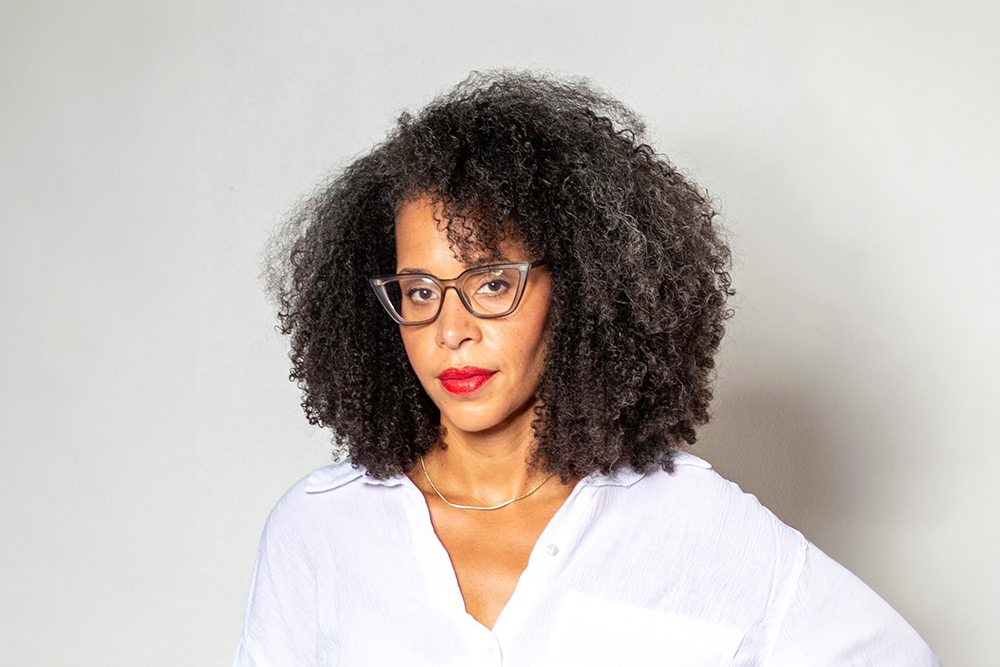
Loira Limbal [she/her] was appointed as President and CEO of Firelight Media in June 2025. Her previous 16 years of service to the organization included roles as lead consultant and Senior Vice President of Programs. Throughout her tenure at Firelight, she has led the expansion of Firelight’s flagship Documentary Lab and the launch of its Groundwork Regional Lab, William Greaves Research & Development Fund, Impact Campaign Fund, and In the Making documentary short film series, produced in partnership with PBS’ American Masters.
Loira is a multidisciplinary artist who works in documentary film and video installation and as a DJ. Her acclaimed film Through the Night (2020), a feature documentary about a 24-hour daycare center, was a New York Times Critics’ Pick, garnered a dupont-Columbia award, was selected for a World Premiere at the 2020 Tribeca Film Festival, and aired on PBS' POV series. Her previous film, Estilo Hip Hop, a feature-length documentary that chronicles the lives of three hip hop activists from Brazil, Chile, and Cuba, aired on PBS in 2009.
Loira's recent accolades include a Guggenheim Fellowship, a Creative Capital Award, a USA Fellowship, a NAACP Image Award nomination, and a Sundance Institute Fellowship. She received a B.A. in History from Brown University and is a proud graduate of the Third World Newsreel's Film and Video Production Training Program. She is a member of the New Negress Film Society and serves on the boards of Movimiento Ananse and Ruta Crítica.